
The Spanish Directorate-General for Taxes (DGT) has confirmed, in Binding Ruling V5005-26 of 1 June 2026, that a company with pending tax losses can extend its corporate purpose and start a new activity while still offsetting those losses against future profits.
It is good news for anyone with negative tax bases who is thinking of reorienting the business. Note that what can stop the offset is not the activity, but the arrival of new majority shareholders.
The case analysed
A real estate company had accumulated negative tax bases. Its only income came from renting out a property. It planned to extend its corporate purpose to the retail of jewellery and costume jewellery. Neither the shareholders nor their percentage holdings were changing.
The DGT concludes that it can offset the losses of the real estate activity against the profits of the new activity.

Why is it possible?
The right to offset negative tax bases is set out in article 26 of Corporate Income Tax Law 27/2014 (LIS). It does not depend on the activity that generated the loss or on the one that earns the future profits.
- The offset has no time limit.
- The restrictions in art. 26.4 LIS revolve around a change of shareholders, not a change of activity.
- Extending the corporate purpose, on its own, does not forfeit the right.
When the right to offset is lost
Losses cannot be offset when the following circumstances occur at the same time:
- A person or entity (or a group of related parties) acquires the majority of the capital or of the rights to share in profits after the year in which the loss arose.
- That person or entity held less than 25 % at the close of that year.
- And the acquired company falls under one of these cases: it had no activity in the 3 months before the purchase; in the following 2 years it carries on an activity in a different CNAE group that exceeds 50 % of its previous average turnover; it is an asset-holding entity; or it has been struck off the entity register.
Changing activity without new majority shareholders does not limit the offset. The risk arises when the entry of a new shareholder and the new activity coincide.
Limits on the offset
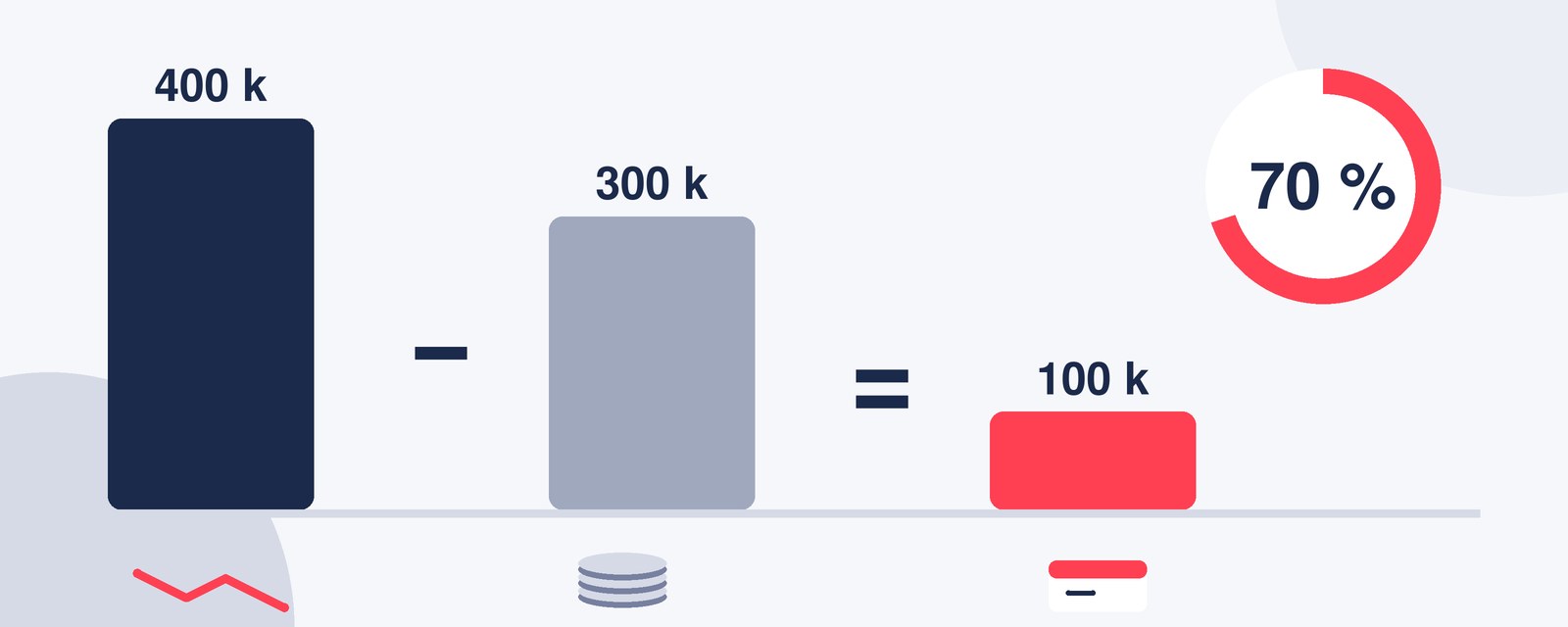
As a general rule, each year you can offset up to 70 % of the prior tax base (before the capitalisation reserve and the offset itself), with a minimum of €1 million.
- Turnover of €20 to 60 million: 50 % limit.
- Turnover of €60 million or more: 25 % limit.
Illustrative example. An SME with €400,000 of pending negative bases and a €300,000 prior base offsets the full €300,000, because the €1 million minimum exceeds 70 %. €100,000 is left for the following year. With a €2 million prior base and €2 million of losses, the limit would be 70 %: it would offset €1.4 million.
Ten years for the tax authority to check them
The tax authority can check negative tax bases for 10 years (art. 66 bis of the General Tax Law). After that, they must be proven with the self-assessment return and the accounts filed with the Mercantile Registry.
That is why it pays to keep the accounts of every loss-making year in order and to keep a year-by-year record of the pending bases.
What a binding ruling is worth
It is not a court judgment. It is the DGT's answer to a written query. It binds the tax authority (art. 89 of the General Tax Law) with regard to the person who asked and any taxpayer whose facts and circumstances are the same. It does not bind the courts.
The ruling relies on the data supplied by the person who asked. Each case must be analysed with its own circumstances.
What to do
If your company has pending negative tax bases and is considering extending its activity, bringing in partners or reorganising the business, talk to us before acting. We quantify the losses that can be offset, check that no art. 26.4 LIS restriction applies and plan the operation.
info@contaldia.com · 931 94 94 80. Sources: Binding Ruling V5005-26 (DGT, 1-6-2026); art. 26 Law 27/2014 on Corporate Income Tax; arts. 66 bis and 89 General Tax Law.
This communication is for information only and is not tax advice. How the criterion applies depends on each taxpayer's circumstances.